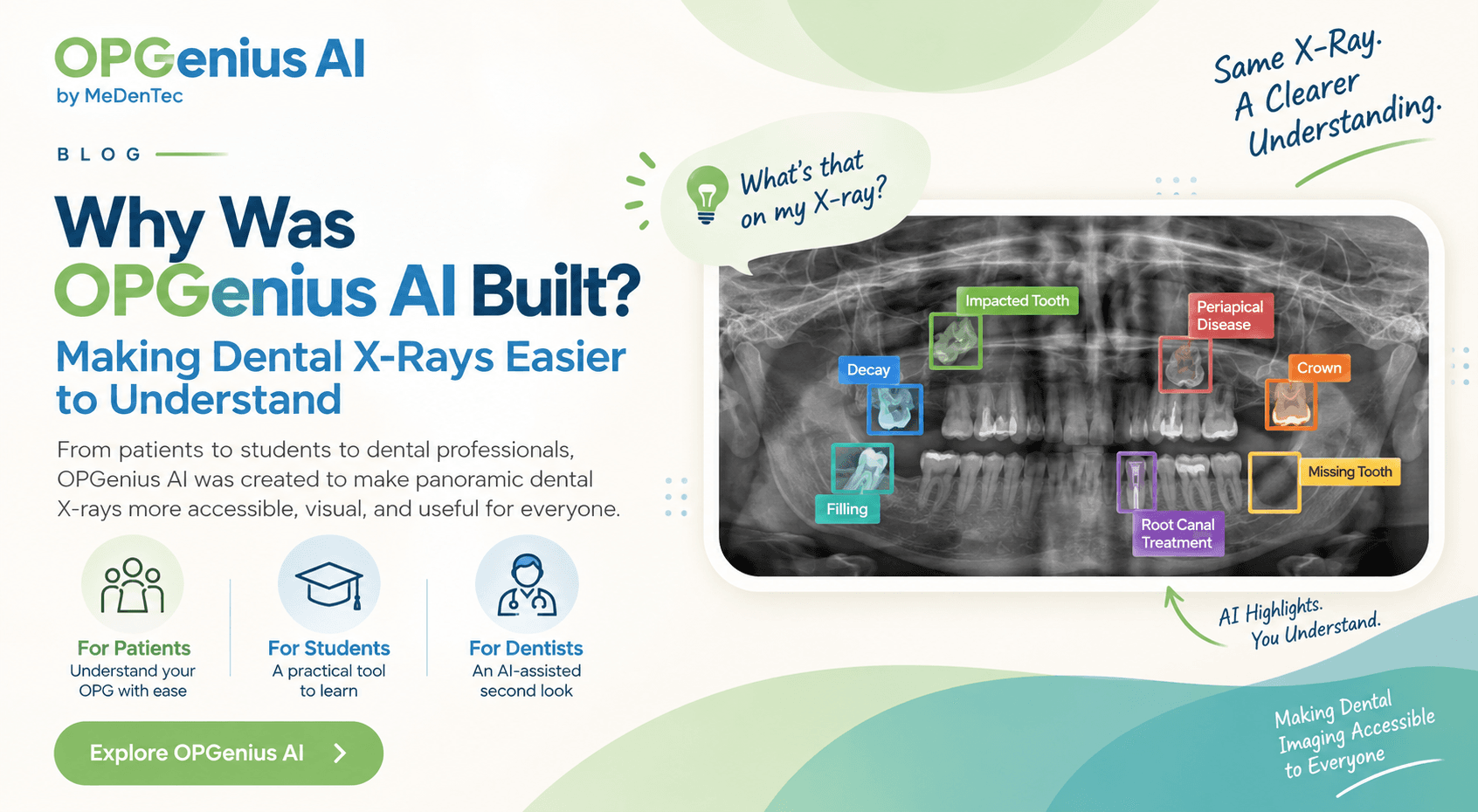
Why Was OPGenius AI Built? Making Dental X-Rays Easier to Understand
Why was OPGenius AI created? Discover how AI-powered OPG analysis can help patients better understand their dental X-rays, support dental students in learning radiographic findings, and provide dentists with an additional layer of AI-assisted suppor
Have you ever received a dental X-ray and thought:
“Okay… but what am I actually looking at?”
You can see teeth, bones, dark and light areas, fillings, maybe an implant or an impacted tooth.
But unless you have a background in dentistry, an OPGcan look like a complicated puzzle.
Even after your dentist explains it, you might leave wondering:
“What did that dark area mean?”
“Which tooth has the problem?”
“What exactly did my X-ray show?”
These questions were part of what inspired OPGenius AI.
The idea wasn't simply to build another AI model that could analyze a panoramic dental X-ray.
The bigger question was:
Can we make the information inside an OPG easier to see, explore, and understand?
And we wanted to do this in a way that could be useful to patients, dental students, and dentists alike.
An OPG provides a broad view of the teeth and jaws in a single image.
For a dental professional, it can contain a wealth of information. For someone without dental training, however, knowing what to look for, and where to look, can be difficult.
You might see:
Teeth
Fillings
Crowns
Implants
Impacted teeth
Root canal-treated teeth
Decay
Periapical findings
Missing teeth
The information is there.
But is it easy to understand?
That was the gap we wanted to address.
What if patients could explore their OPG?
Imagine receiving your OPG after a dental appointment.
Instead of seeing it as one complicated image, you could explore the findings highlighted on the radiograph.
You could ask:
Where is the finding?
Which tooth is involved?
What did the AI identify?
With AI-assisted visualization, a detected finding can be highlighted directly on the OPG, helping users connect the information with its location on the image.
The goal isn't to turn patients into dentists.
It is to help patients better understand the conversation they're having with their dentist.
A learning tool for dental students
Understanding dental radiographs takes practice.
Students need to repeatedly examine images, learn normal anatomy, recognize different findings, and understand how those findings appear radiographically.
An interactive AI tool can provide another way to learn.
A student might ask:
“Where is the impacted tooth?”
Or:
“What does decay look like on this OPG?”
Or:
“Which tooth has a root canal?”
Being able to visualize findings directly on an image can help students connect what they learn in textbooks and lectures with what they see in actual radiographs.
It can serve as an additional educational resource for students learning to approach and interpret panoramic radiographs.
And what about dentists?
The same technology can also provide an additional layer of assistance for dental professionals.
Dentists routinely examine radiographs as part of patient assessment. An AI system can highlight findings it has been trained to recognize, providing another perspective during image review.
Think of it as an additional pair of eyes.
The dentist can review what the AI has highlighted and interpret those findings alongside the patient's history, symptoms, clinical examination, and other relevant information.
The principle is simple:
AI highlights. The dentist interprets.
Clinical expertise remains at the center.
AI shouldn't be limited by a paywall
There is another reason accessibility matters.
Today, there are several AI-powered tools capable of assisting with dental radiograph interpretation. Many of these technologies represent impressive work in dental AI.
But advanced technology can only make an impact if people can actually access it.
When AI tools are expensive or restricted to particular institutions, their potential benefits remain out of reach for many people, including students, researchers, clinicians, and patients who simply want to better understand their dental imaging.
We believe healthcare technology should be accessible and practical, not something that exists only behind a paywall.
That was an important part of the thinking behind OPGenius AI.
The goal was not only to develop AI that could analyze an OPG, but to create an experience where people could actually interact with that technology.
Because what's the point of developing useful technology if the people who could benefit from it cannot access it?
So, why did we build OPGenius AI?
Because we believe a dental X-ray shouldn't have to feel like a foreign language.
A patient should be able to better understand what they're looking at.
A dental student should have tools that help connect theory with real radiographic images.
And a dentist should be able to explore AI as an additional layer of assistance.
Most importantly, we believe that useful healthcare technology should be accessible not reserved for those who can afford it.
That's the idea behind OPGenius AI.
Not simply to analyze an OPG.
But to help people see, explore, and understand what's inside it.
Have an OPG?
Upload your panoramic dental X-ray and explore what OPGenius AI can identify.
Want to see AI-powered dental analysis in action?
Try a Free OPG Scan