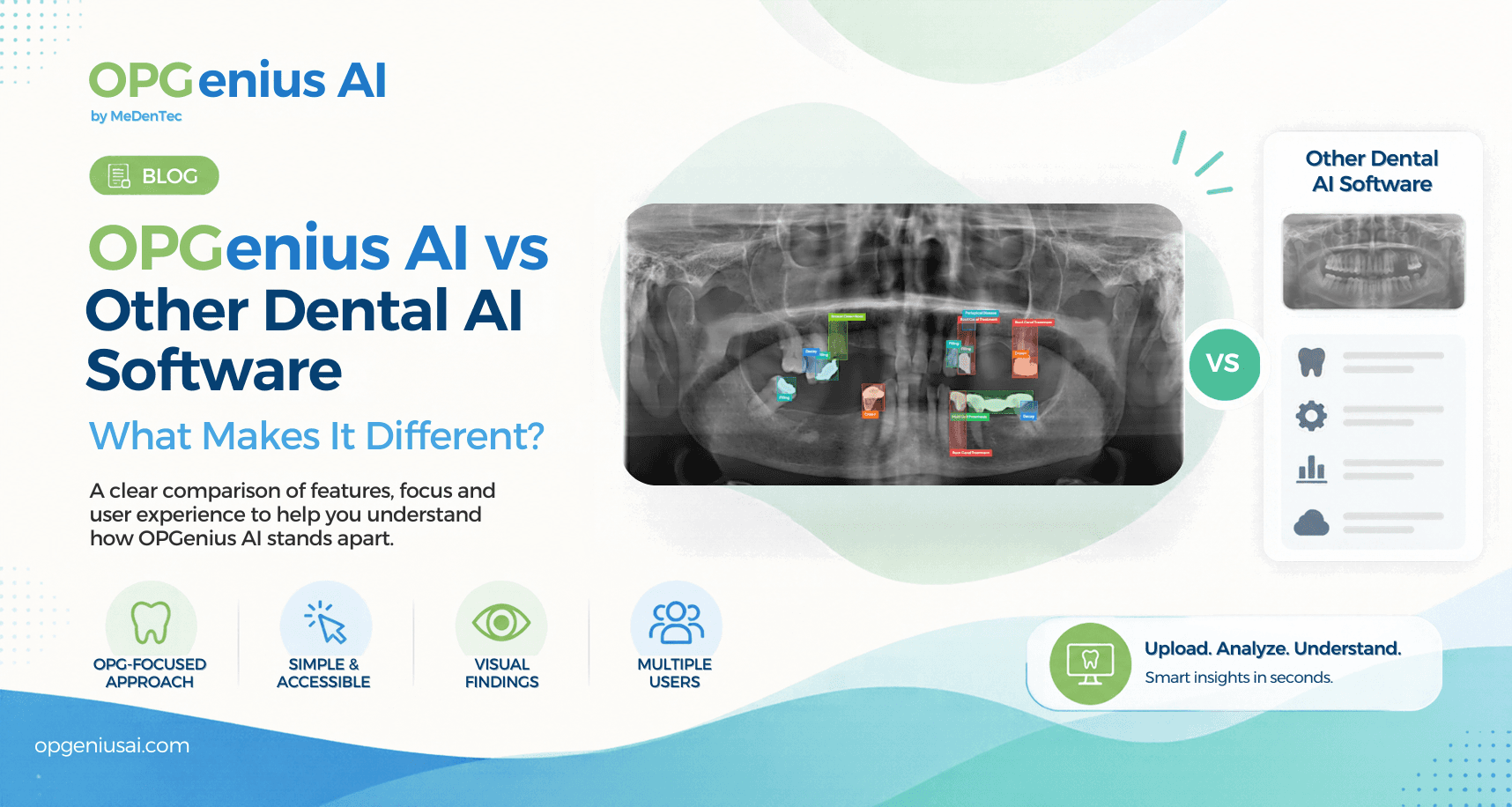
OPGenius AI vs Other Dental AI Software: What Makes It Different?
How does OPGenius AI compare with other dental AI software? Explore how its OPG-focused, accessible, and visual approach makes panoramic X-ray analysis easier to use for dentists, students, researchers, and patients.
Dental AI is changing quickly.
Today, dentists can choose from AI platforms that analyze dental X-rays, detect potential findings, enhance images, support clinical decision-making, improve patient communication, integrate with practice-management systems, and even provide practice-level analytics.
With so many options available, a natural question is:
What makes OPGenius AI different from other dental AI software?
1. OPGenius AI focuses on the OPG
Dental AI can cover a very broad range of imaging.
Some platforms analyze intraoral radiographs, panoramic radiographs, and CBCT scans. Diagnocat, for example, currently offers AI analysis across all three modalities.
Other platforms are designed as comprehensive dental imaging ecosystems.
Overjet's current platform, for example, combines imaging, AI analysis, image enhancement, patient presentation, practice-management integration, and other workflows.
OPGenius AI takes a different route.
It focuses specifically on the panoramic radiograph.
What can AI help me see in this OPG?
That focused experience is at the heart of OPGenius AI.
2. It's built around a simple upload-and-explore experience
For many AI platforms, AI analysis is part of a larger clinical workflow.
The software may need to integrate with imaging systems, sensors, patient-management systems, or other practice infrastructure. Overjet, for example, describes integrations with existing imaging and practice-management systems as part of its workflow.
OPGenius AI approaches the experience differently.
You have an OPG.
You upload it.
The AI analyzes it.
And the findings appear directly on the radiograph.
The current OPGenius mode allows users to try an OPG scan without creating an account, with results displayed on screen and a downloadable PDF report available.
Upload → Analyze → Explore → Understand
3. Accessibility is a core part of the approach
This is one of the clearest differences in positioning.
Many dental AI platforms are designed primarily for professional clinical environments, practices, healthcare organizations, or enterprise workflows.
OPGenius AI was built with a different question in mind:
Can AI-powered OPG analysis be made accessible to anyone who wants to explore it?
The current OPGenius AI public experience is free to use, without login.
That means a dental student doesn't necessarily need access to an enterprise dental AI system just to explore an OPG.
A researcher doesn't necessarily need to navigate a large clinical software ecosystem.
And a patient can explore an AI-generated visualization of their own radiograph before discussing it with their dentist.
Accessibility isn't an afterthought. It's part of the product philosophy.
4. OPGenius AI is designed to show you where the finding is
An AI-generated list can tell you what was detected.
But an annotated image can show you where it was detected.
That's an important difference in how people interact with radiographs.
OPGenius AI uses color-coded markers to highlight AI-detected findings directly on the OPG.
Depending on the current model and platform configuration, findings include conditions and existing dental work such as:
Decay
Periapical disease
Root canal treatment
Crowns
Implants
Fillings
Broken-down roots
Impacted teeth
Users can explore individual findings and review associated tooth numbers within the results interface.
Instead of simply receiving:
“Finding detected.”
The experience becomes:
“Here is the finding. Here is where it appears.”
5. OPGenius AI is designed for different types of users
Another part of the OPGenius AI approach is its accessibility to different audiences.
Dentists
For dentists, OPGenius AI can provide an additional layer of AI-assisted information while reviewing panoramic radiographs which can act as another point of reference.
Dental Students
For students, radiographic interpretation is largely about exposure and pattern recognition.
The more real radiographs you see, the more familiar you become with different findings.
OPGenius AI can provide an interactive way to explore findings on panoramic radiographs and connect theoretical knowledge with real images.
Researchers
Researchers working in dental imaging and artificial intelligence may also benefit from having an accessible web-based tool for exploring OPG analysis.
The simpler the interface, the easier it can be to explore the technology without first navigating a complex clinical software environment.
Patients
Patients often receive their OPG but have no idea what the image means.
An AI overlay doesn't turn a patient into a dental professional.
But it can make the conversation easier.
Instead of asking:
“What am I looking at?”
a patient may be able to ask:
“What does this highlighted area mean?”
And that's a much more useful starting point for a conversation with their dentist.
6. OPGenius AI doesn't replace clinical judgment
This is perhaps the most important point in any comparison of dental AI.
AI can highlight a potential finding.
But an AI-generated highlight is not automatically a diagnosis.
A dentist considers the complete clinical picture, including:
Patient history
Symptoms
Clinical examination
Radiographic findings
Previous treatment
Other imaging
Patient-specific factors
That's why OPGenius AI should be viewed as an AI-assisted tool, not a replacement for professional dental assessment.
AI highlights. The dentist interprets.
7. So, what actually makes OPGenius AI different?
OPGenius AI is focused.
Focused on the OPG.
OPGenius AI is accessible.
Designed so users can try AI-assisted OPG analysis without a complicated setup.
OPGenius AI is visual.
Findings are highlighted directly on the radiograph.
OPGenius AI is exploratory.
Users can interact with the findings rather than simply receiving a list of results.
OPGenius AI is designed for multiple audiences.
Dentists, dental students, researchers, and patients can all interact with the platform for different purposes.
The future of dental AI isn't one-size-fits-all
Dental AI is evolving rapidly.
Some platforms are building comprehensive ecosystems that combine imaging, AI, practice management, analytics, patient communication, and operational tools.
Others are focusing on specific imaging modalities or clinical applications.
There is room for different approaches.
For OPGenius AI, the approach is straightforward:
Take an OPG. Use AI to highlight what it can identify. Make those findings easy to explore. And make the technology accessible.
Have an OPG?
Upload your panoramic dental X-ray and explore what AI-assisted analysis can identify.
Upload → Analyze → Explore → Understand
Want to see AI-powered dental analysis in action?
Try a Free OPG Scan