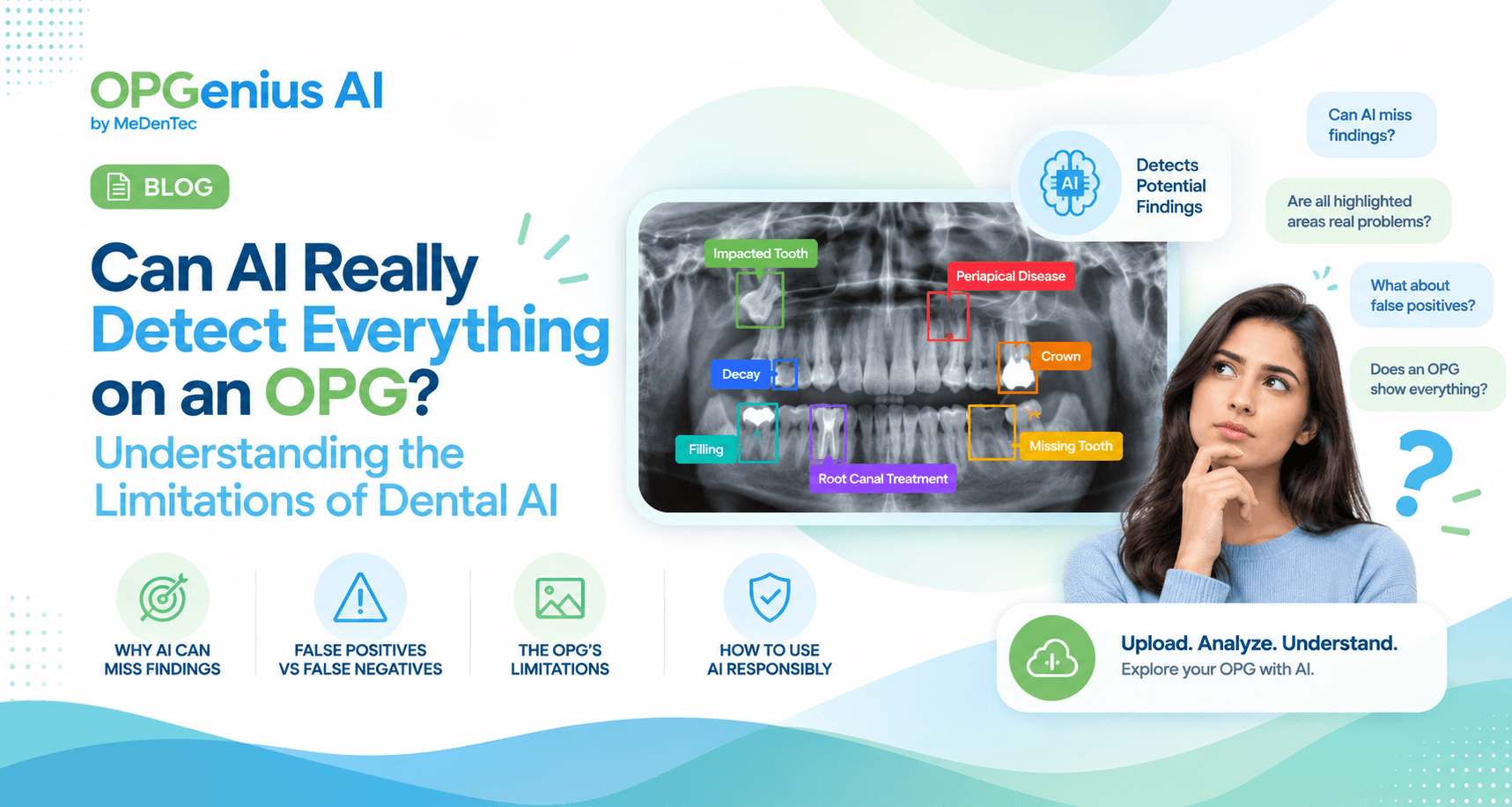
Can AI Really Detect Everything on an OPG? Understanding the Limitations of Dental AI
Can AI detect everything on an OPG? Learn about false positives, false negatives, image quality, OPG limitations, and why AI-assisted analysis doesn't replace a dentist.
Imagine uploading your OPG to an AI tool.
A few seconds later, the image comes back with colorful boxes highlighting different areas.
Decay. Filling. Crown. Impacted tooth. Periapical disease.
It can look impressive.
And naturally, you might wonder:
“If AI can identify all of these things, can it detect everything on my OPG?”
The short answer is:
No.
And understanding why is actually one of the most important parts of using dental AI responsibly.
AI can be incredibly useful for identifying patterns in medical and dental images.
But no AI system should be treated as an all-knowing diagnostic tool.
When we say an AI model detects something on an x-ray, we're talking about a model identifying a visual pattern that it has been trained to recognize.
For example, an AI model may be trained to recognize radiographic patterns associated with:
Decay
Periapical findings
Crowns
Fillings
Implants
Impacted teeth
When the model analyzes a new OPG, it looks for patterns that resemble what it learned during development.
If it finds a pattern it considers relevant, it may highlight it.
But there's an important distinction:
Detection is not the same as diagnosis.
1. AI can miss findings
One of the most important limitations of any AI detection system is the possibility of a false negative.
A false negative occurs when a finding is actually present, but the AI doesn't identify it.
So, if you upload an OPG and the AI doesn't highlight a particular area, you should not automatically assume that the area is normal.
Why might an AI miss something?
There are many possible reasons.
The finding might:
Be difficult to distinguish from surrounding anatomy
Be subtle
Appear differently from examples the model learned from
Be affected by image quality
Be obscured by overlapping structures
Fall outside the model's intended detection capabilities
This is why:
No AI highlight ≠ guaranteed absence of disease.
2. AI can also flag something that isn't actually a problem
The opposite can happen too.
An AI may identify something as a potential finding when it isn't clinically significant.
This is known as a false positive.
For example, an area may have an appearance that resembles a particular radiographic finding even though another explanation is more appropriate.
A dentist can investigate that finding in context.
3. OPGs have their own limitations
There's another important point that has nothing to do with AI.
The OPG itself has limitations.
A panoramic radiograph provides a broad overview of the teeth and jaws, but it doesn't show every structure or every condition with the same level of detail.
There can be:
Overlapping structures
Distortion
Magnification
Positioning effects
Differences in image quality
Anatomical structures that obscure areas of interest
That's one reason dentists don't rely on a single radiograph for every clinical decision.
Depending on the situation, a dentist may request additional imaging or perform a clinical examination.
4. Image quality matters
Think about trying to recognize a small object in a blurry photograph.
Now imagine asking AI to do the same thing.
The quality of the input image matters.
For OPG analysis, an original digital radiograph is generally preferable to:
❌ A photograph of a printed X-ray
❌ A blurry screenshot
❌ A distorted image
❌ A very low-resolution copy
The better the image represents the original radiograph, the more useful the AI analysis can potentially be.
This is why OPGenius's guidance recommends using the original digital OPG.
5. AI only knows what it was designed to look for
Here's another important concept:
AI doesn't automatically understand everything visible in an image.
Imagine you train an AI system specifically to recognize cars.
You show it thousands of examples of cars.
Then you give it a photograph of a tree.
It doesn't suddenly become an expert botanist.
The same principle applies to dental AI.
If a system has been designed and evaluated for particular dental findings, that doesn't mean it can reliably identify every possible abnormality visible on an OPG.
So, when using any dental AI platform, one of the first questions should be:
“What exactly is this AI designed and evaluated to detect?”
6. What about OPGenius AI?
OPGenius AI is designed to help users explore AI-assisted findings on panoramic dental radiographs.
The platform can highlight findings such as:
Decay • Periapical Disease • Root Canal Treatment • Crowns • Implants • Fillings • Broken-Down Roots • Impacted Teeth
These highlights can make it easier to see where potential findings appear on an OPG.
But OPGenius isn't designed to tell you:
“You definitely have this disease.”
Instead, the goal is to provide an additional layer of information that can support exploration, education, and discussion with a dental professional.
7. What if OPGenius AI doesn't highlight something?
This is worth repeating because it's easy to misunderstand AI results.
An AI model can miss findings.
And some conditions may not be well visualized on an OPG in the first place.
So, if you're experiencing symptoms, don't ignore them simply because an AI analysis doesn't highlight anything.
If something hurts, feels different, is swollen, or concerns you, speak with your dentist.
Your symptoms still matter.
The right way to think about dental AI
Don't ask:
❌ “Can AI diagnose my entire mouth?”
Instead, ask:
✅ “What is this AI designed to detect?”
✅ “How was it evaluated?”
✅ “What happens if it misses something?”
✅ “What should I do with the result?”
✅ “How does this fit into professional dental assessment?”
Those questions lead to much more responsible use of AI.
Have an OPG?
Upload your panoramic dental X-ray to OPGenius AI and explore what AI-assisted analysis can identify.
Upload → Analyze → Explore → Understand
AI-generated results are for informational purposes only and should not replace professional dental diagnosis or consultation.
Want to see AI-powered dental analysis in action?
Try a Free OPG Scan